

Earlier this week, while we were exploring the small town of Crisfield, Maryland, turning over rocks to see what we could find, my husband and I found ourselves at the city dock where three boats were being loaded with supplies. I approached the biggest boat, the Courtney Thomas, and asked the man leaning against the rail if this was the mail boat to Tangier Island. “Yes, it is,” he said.
We had read about the mail boat in the book Chesapeake Requiem. I asked if we could ride along, and he said, “Sure.” He told us the boat leaves every day at 12:30 p.m., except for Sundays, and for $35 per person, we could squeeze in between the boxes or take a seat in the passenger cabin below. We introduced ourselves. He said his name was James. I could see the wheels turning in Mickey’s head when he asked, “Are you Oo…?” James finished Mickey’s sentence with, “Yes, Ooker is my nickname.”
Mickey said, “You are in the book we are reading.” Ooker knew the book. He also told us about a documentary he is featured in called “Be Here, Stay Here.”
We almost got on the boat right then, but since we had already been bumming around town for a few hours, we decided to make a fresh start on Wednesday.
We got there early and watched trucks back in, one after the other, with plywood, 2 x 4s, bags of concrete, cases of water, a child’s bicycle, and finally a U.S. Postal Service truck stacked with Amazon boxes. It felt like Christmas.
The last truck to unload was full of produce. One by one, they loaded watermelons and cantaloupes onto a raised portion of the bridge deck. A local woman inquired about buying one of the small watermelons, and the produce man said they were nine dollars each. She passed.
We found a place to sit on the foredeck, leaning our backs against the captain’s helm—a first-class seat if there ever was one—and at 12:30 on the minute, we pulled away from the dock.
The boat easily bounced along the waves with the helm providing just enough shelter from the wind. After losing more than one hat off the side of a boat, I took it off and held on to it.


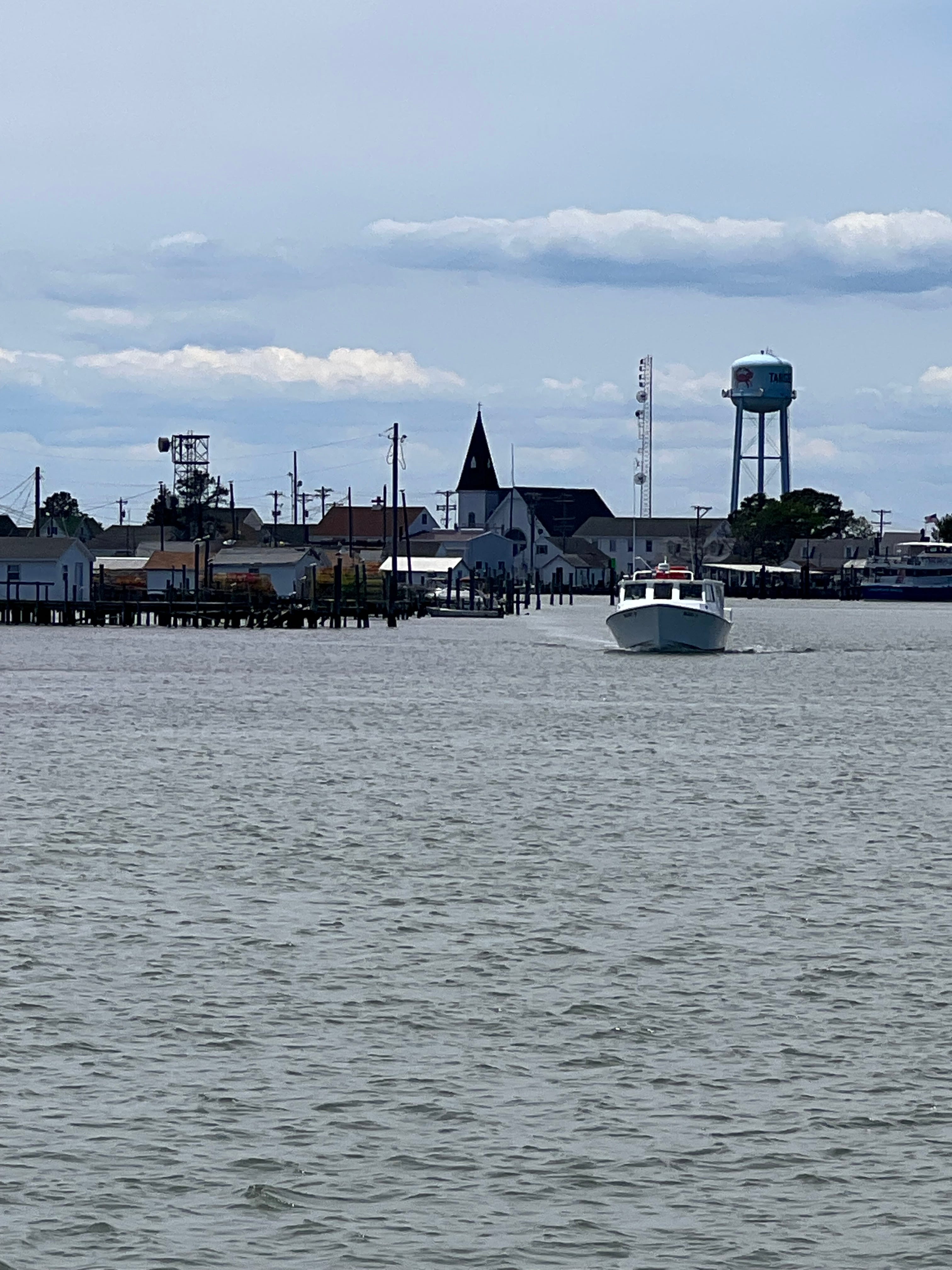
When Tangier Island came into view, the first thing I noticed was the church steeple, a landmark that had guided many a sailor into the cove.
As we got closer, the crab shanties began to come into view with docks in various states of disrepair, weathered and beaten from the relentless pounding of gale-force winds and water.
Our captain masterfully parked the boat in a place that didn’t look deep enough or wide enough for a skiff. We climbed off the boat and made our way through a maze of golf carts with islanders anxiously awaiting their packages.
We had no idea where to go, so we walked down a narrow street until we saw a sign for Lorrainne’s Seafood with an open sign in the window.
We had two and a half hours until we could catch a ride back with another boat making a daily run to Crisfield. There were no signs for the “City Dock,” but a man who had missed the boat before assured us that he was at the right dock. Speaking from experience, he said, “You don’t want to miss the boat.” Mickey ran over to the first dock, where a couple of women were sitting on cinderblocks, to let them know they needed to come to the other dock.
The man proved to be right, as the Elizabeth Joy II pulled up to the dock five minutes before 4 p.m. It was already loaded with bushels of crabs and boxes of oysters harvested that day. We climbed into the boat along with a handful of others and sat on a bench. There were also a few patio chairs stacked up if you could find a place to put one.
That was basically the itinerary for the whole visit—wandering down narrow streets, reading a couple of historical markers, and looking at homes, churches, old boats gone ashore, and lots of headstones. I think it is safe to say there are more dead residents on the island than living.
I love to walk through neighborhoods of all kinds. People’s homes are an outward expression of themselves, the paint colors, the flowers, and the entrance. If you came up to my front door, you would find out a whole lot about me by just taking a look around.
But on Tangier Island, I almost felt like I was intruding—a stranger walking their roads, peering into their lives as if they were part of a museum exhibit. It reminded me of people I met in Guatemala after mudslides and earthquakes destroyed their homes. They didn't talk about leaving. They picked up the pieces and rebuilt the life they'd always known.


The future has always been uncertain, and Tangier Island is no exception. Many scientists believe much of Tangier Island could become uninhabitable within the coming decades because of erosion, sea-level rise, and sinking land.
Moment by moment, they are living their lives—getting up early, harvesting crabs and oysters, raising families, and teaching a new generation how to navigate a boat on the Chesapeake Bay and beyond.
Years ago, after a house concert in Pennsylvania, a friend challenged me. “Everyone writes songs about people who leave. I want you to write a song about someone who stays.”
I did.
Bumping across the Chesapeake that afternoon, I realized I’d been writing about the people of Tangier Island long before I ever set foot there.
It’s about a place that holds their hearts, and it holds their souls…
There are always those who leave and those who stay.
A few miles out, Captain Allen Parks told his twelve-year-old son Jacob to take the wheel of the Elizabeth Joy II. Elizabeth is Allen’s wife’s name, and Joy is his mother’s name. Jacob is learning the family business. As it turns out, that night I found another short video, Tangier Island: The Heart of the Chesapeake," that just happened to have interviews with Allen and Jacob. One minute I’m watching them on the boat, and the next on YouTube. Synchronicity.
There’s never been a reason good enough to go,
‘cause it’s about a place they call home.
The best reason to take a trip out to Tangier Island is to eat lunch. Hands down, it was the best and freshest crab cake sandwich I’ve ever had, served on plain bread with chips—no frills. For all I know, the waterman who brought in the morning’s catch was sitting at the corner table. Mickey had the softshell crab. He agrees.
Tangier Island reminded me that the richest places aren’t always the ones with the biggest attractions. They’re the places where people are still living the only life they’ve ever known—a home that isn’t simply where they live, but where they’ve chosen to stay.
But there is still one claim to fame that deserves to go down in history.
Congratulations! You did it! The World’s Best Crab Cake Sandwich!
I've been enjoying reading about y'all's adventures. Love y'all!